
Automation | Candidate Resources | Employer Resources | Executives | Industrial Technology | Podcast
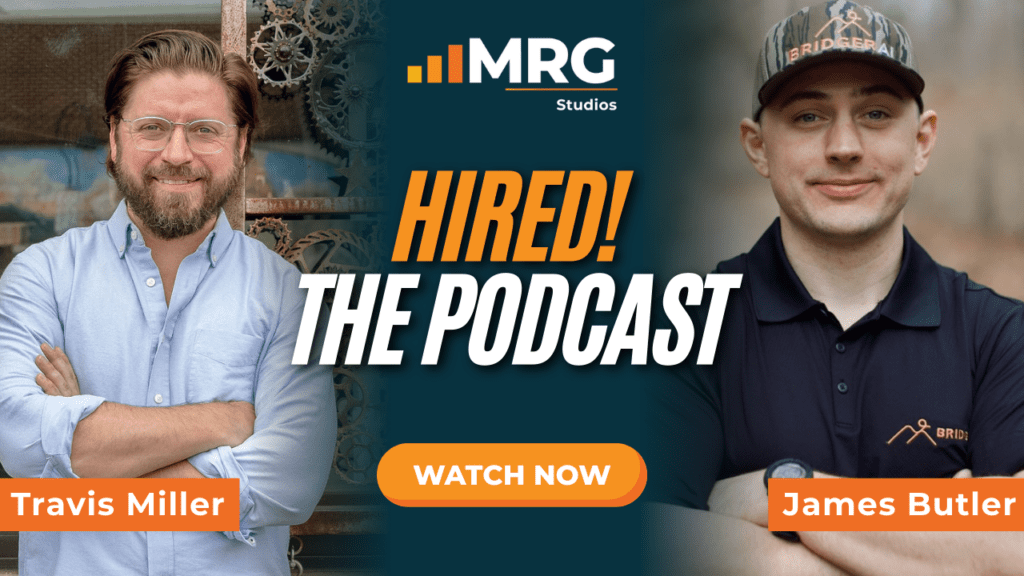
HIRED! The Podcast (Ft. James Butler) | Ep. #63
Starting an Automation Company With No Safety Net
Hiring in automation looks logical on paper. Degrees, resumes, years of experience. But the moment you are the one signing checks, those neat assumptions fall apart fast.
That tension sits at the center of the latest episode of HIRED! The Podcast, where host Travis Miller sits down with James Butler, Founder and President of Bridger Automation. Butler’s story spans electrical work, controls engineering, and eventually the leap into entrepreneurship. It is not a victory lap. It is a real look at what changes when responsibility shifts from employee to owner.
As Butler explains it, the biggest differences are not technical. They are personal.
When the risk becomes real
Hiring as an employee carries weight. Hiring as the owner carries consequences.
Once you run the company, a bad hire is no longer an inconvenience or a delay. It is months of wages, training time, and lost momentum that small automation firms cannot easily absorb. Butler puts it plainly. Training the wrong person for six months means paying twice when you have to start over.
This reality reshapes how founders think about talent. Experience still matters, but it is no longer the top filter. Reliability, communication, and curiosity rise quickly to the surface.
As Butler notes, “It’s ultimately about communicating with the customer and being a good person. Those are the two number one things I look for.”

Why curiosity matters more than polish
Technical skill can be taught. Curiosity cannot.
Butler’s hiring philosophy favors younger engineers who want to learn fast over veterans who arrive fully formed. The goal is not to avoid experience. It is to avoid stagnation. In warehouse automation especially, projects never go exactly as planned. The people who succeed are the ones who ask questions early, communicate issues clearly, and stay engaged when things break.
Curiosity shows up in unexpected ways during interviews. Butler often looks outside work entirely. How candidates spend their free time, what excites them, and whether they pursue interests beyond a job description all offer clues about how they will behave on a project site.
That curiosity, paired with communication, becomes the difference between a technician and a partner.

Building culture without hiding from accountability
Early-stage companies face a cultural paradox. Founders want tight teams that feel like family, but they also need structure that keeps the business alive.
Butler speaks openly about the difficulty of balancing empathy with expectations. Small companies cannot enforce policies the same way global enterprises can. Every decision feels personal. But avoiding accountability creates its own risks. Customers still expect delivery. Cash flow still matters. Projects still need to finish.
Leadership, in this context, becomes an exercise in clarity. When people understand why standards exist, and how their work connects to outcomes, enforcement stops feeling arbitrary. It becomes necessary.
A shifting automation landscape
Beyond hiring, Butler also offers a clear-eyed view of where warehouse automation is heading.
Controls engineers remain scarce, and in many cases underpaid relative to their impact. While software talent is abundant, experienced controls engineers capable of commissioning full systems remain difficult to find. That imbalance is unlikely to resolve quickly.
At the same time, automation itself is moving downstream. Instead of massive, multi-million dollar systems, Butler sees growth in smaller, modular solutions designed for companies adopting automation for the first time. Micro fulfillment, mobile conveyors, and cost-effective sortation are opening the door for new adopters who were previously priced out.
More automation is coming. It just may not look like the systems people expect.
The full conversation
This episode of HIRED! The Podcast explores what it really takes to build an automation business from the ground up. From capital risk and hiring pressure to leadership, culture, and the future of controls engineering, Butler’s experience offers a grounded look at growth without a safety net.
The full conversation dives deeper into these topics, including the personal risks behind entrepreneurship and the long-term outlook for automation talent.
Watch or listen to the full episode of HIRED! The Podcast featuring James Butler, hosted by Travis Miller.
James Butler is the President and Founder of Bridger Automation, specializing in warehouse automation, conveyor controls, electrical integration, and WCS software. He brings hands-on experience from electrical work to software integration and commissioning, with a focus on building practical, scalable automation solutions.

Want to connect with our team? If you are navigating workforce growth, innovation, or leadership challenges, we would love to talk. Get in touch here.
Enjoyed the episode?
Explore our other newsletters for more curated content to help you navigate your career and stay informed on the latest industry trends.
[Explore Our Newsletters and Subscribe Here]